
Houston ISD Expanding New Education System to 9 More Elementary Schools for 2026-27

HOUSTON — Houston Independent School District announced nine additional elementary campuses will transition into the district’s New Education System (NES) for the 2026-27 school year, continuing the expansion of the district’s education reform model that officials say has produced three consecutive years of academic growth.
The campuses joining NES next school year are:
- Barrick Elementary School
- Bastian Elementary School
- Benbrook Elementary School
- Burnet Elementary School
- Carrillo Elementary School
- E. White Elementary School
- Foster Elementary School
- Garcia Elementary School
- Law Elementary School
District leaders said all nine campuses had already spent at least a year implementing portions of the NES curriculum before formally joining the model.
Kasey Bailey said the district continues attracting educators interested in transformation-focused instruction.
“We are continuing to attract educators who really are not afraid of transformation and want to do what’s best for kids,” Bailey said. “Whether your students are closing gaps or mastering the academic content, the NES model can support and meet those needs.”
Aligning District Funding
One of the major differences between NES and non-NES campuses is funding.
According to HISD, NES campuses receive approximately $8,566 per student annually, compared to $6,133 at non-NES campuses.
District officials said the additional funding helps provide:
- Teacher salary increases of up to $9,000 for the 2026-27 school year
- Learning coaches
- Teacher assistants
- Teacher apprentices and residents
- Additional enrichment and instructional support
HISD said these support staff members assist with lesson preparation, differentiated instruction, and behavioral support while reducing the need for substitute teachers.
The NES model also uses district-standardized curriculum materials that include detailed lesson plans, daily learning objective tracking, and instructional adjustments based on student performance.
Officials said the model was originally implemented at campuses needing significant academic improvement, but interest later expanded to schools seeking to sustain strong academic growth.
While no campuses joined NES during the 2025-26 school year, HISD reopened the application process for selected campuses next year.
Bailey said schools showing stagnant academic performance or achievement gaps were strong candidates for the program.
“Any stagnation in overall campus performance shows you need a stronger instructional model with additional support to get the best teachers,” Bailey said.
Two additional campuses, Mading Elementary School and Pleasantville Elementary School, will also transition into NES after absorbing students from the closing Alcott Elementary School and Port Houston Elementary School campuses.
Foster Elementary: “Excellence Expected” as Campus Formalizes NES Transition
At Foster Elementary School, principal Felicia James described the transition as an extension of work already happening on campus.
“This was a simple decision because this strengthens and scales the work that we are doing,” James said. “We are not starting from scratch here. We’re building from a foundation of strong systems, high expectations and a clear focus on instruction.”
Step into the Team Center
One of the campus’ instructional tools is its “Team Center,” where students who demonstrate mastery of classroom lessons move into more advanced coursework supported by teacher aides and residents.
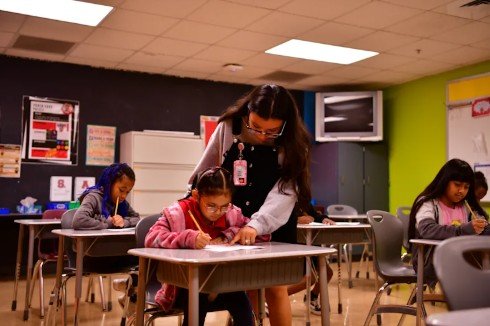
Teacher resident Samantha Avila said students are eager to participate.
“They’re always so excited and proud to be pushed out into the learning center,” Avila said.
The Team Center model allows teachers to focus more directly on instruction while support staff provide additional assistance to students who need remediation or behavioral support.
James said the added staffing support prevents educators from becoming overwhelmed.
“The model prevents staff from wearing themselves thin so everybody can just focus on their load,” she said.
Teachers Lead the Charge
Veteran Foster teacher Courtney Noble said the NES curriculum has improved instructional planning and student engagement.
“We have more resources and more time to construct better lessons,” Noble said. “This will allow students to achieve at a higher level.”

Fourth-grade English teacher Fern Oglesby will teach “Art of Thinking” next year, a course focused on critical thinking and real-world problem solving.
Oglesby said the class gives students opportunities to explore larger social and analytical questions that traditional classroom schedules often do not allow.
“Kids have that opportunity to ask ‘Is this the way life should work?’” Oglesby said. “We should have had this when I was in school.”
Professional Communities of Support
Foster staff also participate in Professional Learning Communities (PLC) and “Demo Day” sessions, where teachers review instructional data and practice classroom presentations before teaching lessons.
Avila said the collaborative environment has helped prepare her for a future teaching role on campus.
“The other teachers will give us feedback and constructive criticism, things we could do better, things we did well,” she said. “That’s how we get better as a campus.”
Carrillo Leverages ESL and Gifted Programs Ahead of NES Adoption
Carrillo Elementary School is also preparing for a major transition as it officially adopts NES while welcoming students from the closing Briscoe Elementary School.
Principal Taren Land said increased staffing support is especially important for the school’s large population of English learners and gifted students.
“Human capital by far is the top resource that I could ask for,” Land said. “We were already running the NES, and we know it works. Now, we can do it even better.”
Supporting a Diverse Community
Approximately 69% of Carrillo students are emergent bilingual learners.
Fourth-grade ESL teacher Krystal Castro-Saavedra said the NES curriculum includes vocabulary guides, sentence stems, visuals, and built-in language-learning supports.
“Those who are English language learners have a larger learning curve to assimilate to the school, to the country, to the language,” Castro-Saavedra said.
Land said Carrillo currently has one learning coach and two teacher apprentices but will expand to five teacher apprentices and four learning coaches under NES next year.
Expanding the Gifted and Talented Program
As one of HISD’s Vanguard Magnet campuses, Carrillo also plans to expand gifted-and-talented enrichment opportunities.

GT coordinator Julieta Ortiz said students participate in “Genius Hour” projects involving research, creativity, and interdisciplinary learning.
“We are creating problem solvers from a young elementary age,” Ortiz said. “We teach them there’s always more than one solution to a problem.”
Students described projects connecting literature with science, history, and engineering concepts, including detailed recreations of fictional islands and historical analysis projects.
Under NES, all students will eventually participate in “Art of Thinking” classes and additional enrichment periods led by community experts.
Land said the expanded programming aligns with Carrillo’s long-term mission.
“We want to be a GT magnet that brings in students who are ready to be challenged academically,” Land said. “That’s why this new programming is so important.”
Moving Forward
District officials said the expansion is part of HISD’s broader effort to have all campuses reach “A” or “B” accountability ratings by August 2027.
Bailey said the district will continue investing in underserved communities and campuses requiring additional support.
“Until 100% of kids are reading and doing math at grade level at a mastery level, there’s always a need for a sustained model,” Bailey said.