

NTSB Blames Cell Phone Distraction, Poor Lookout for Fatal Houston Ship Channel Collision
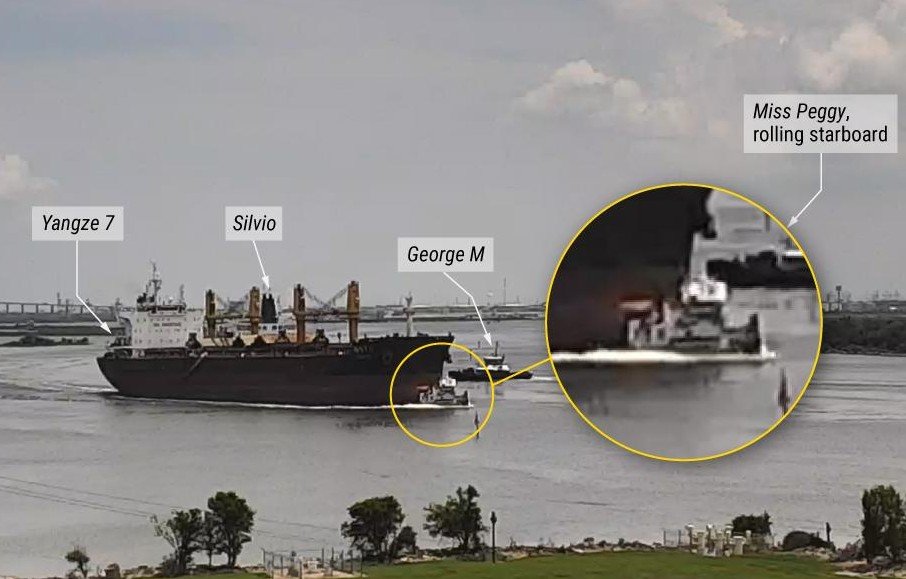
WASHINGTON. The National Transportation Safety Board has concluded that a Houston pilot’s prolonged personal cell phone conversation and failures by both vessel crews to maintain a proper lookout caused a fatal collision in the Houston Ship Channel that left one mariner dead.
The findings were released Thursday, August 6, 2026, in the NTSB’s final report on the July 19, 2024, collision between the bulk carrier Yangze 7 and the towing vessel Miss Peggy near Lynchburg, Texas.
The collision occurred while both vessels were inbound in the Houston Ship Channel.
The Miss Peggy capsized and sank with five crewmembers aboard. Four were rescued by a nearby Good Samaritan vessel, although one sustained serious injuries. A fifth crewmember was later found dead inside the sunken towboat.
Pilot Spent 39 Minutes on Personal Call
According to the NTSB, the Houston pilot directing the Yangze 7 had been engaged in a nonoperational phone call with another Houston pilot for 39 minutes before the collision.
Investigators said the other pilot was simultaneously directing the movement of a different vessel.
The call ended just two minutes and 16 seconds before the collision, but investigators concluded the lengthy conversation distracted the pilot from his navigation duties and left him unaware of the Miss Peggy‘s presence.
The report also found that the captain of the Miss Peggy failed to maintain a proper lookout and did not detect the Yangze 7 approaching from behind. Likewise, the Yangze 7 bridge team failed to identify the towboat until it was less than one ship’s length ahead.
The NTSB noted that maritime regulations and long-established navigation practices require vessel operators to maintain a proper lookout using all available means to ensure safe navigation.
Safety Recommendations Issued
As a result of the investigation, the NTSB issued two new safety recommendations.
The agency urged the U.S. Coast Guard to prohibit individuals directing vessel movements from using personal electronic devices for nonoperational purposes while navigating waterways under its jurisdiction.
The NTSB also recommended the American Pilots’ Association develop and implement guidance prohibiting nonoperational personal electronic device use by pilots actively directing vessel traffic and encourage member organizations to adopt similar policies.
According to the NTSB, distraction from personal electronic devices has been identified as either a contributing factor or the probable cause in at least 10 marine accidents between 2009 and 2024, resulting in three deaths and 45 injuries.
The board determined the probable cause of the collision was the loss of situational awareness by the Houston pilot, the Yangze 7 bridge team and the captain of the Miss Peggy due to their failure to maintain a proper lookout, with the pilot’s distraction from personal cell phone use serving as a contributing factor.